

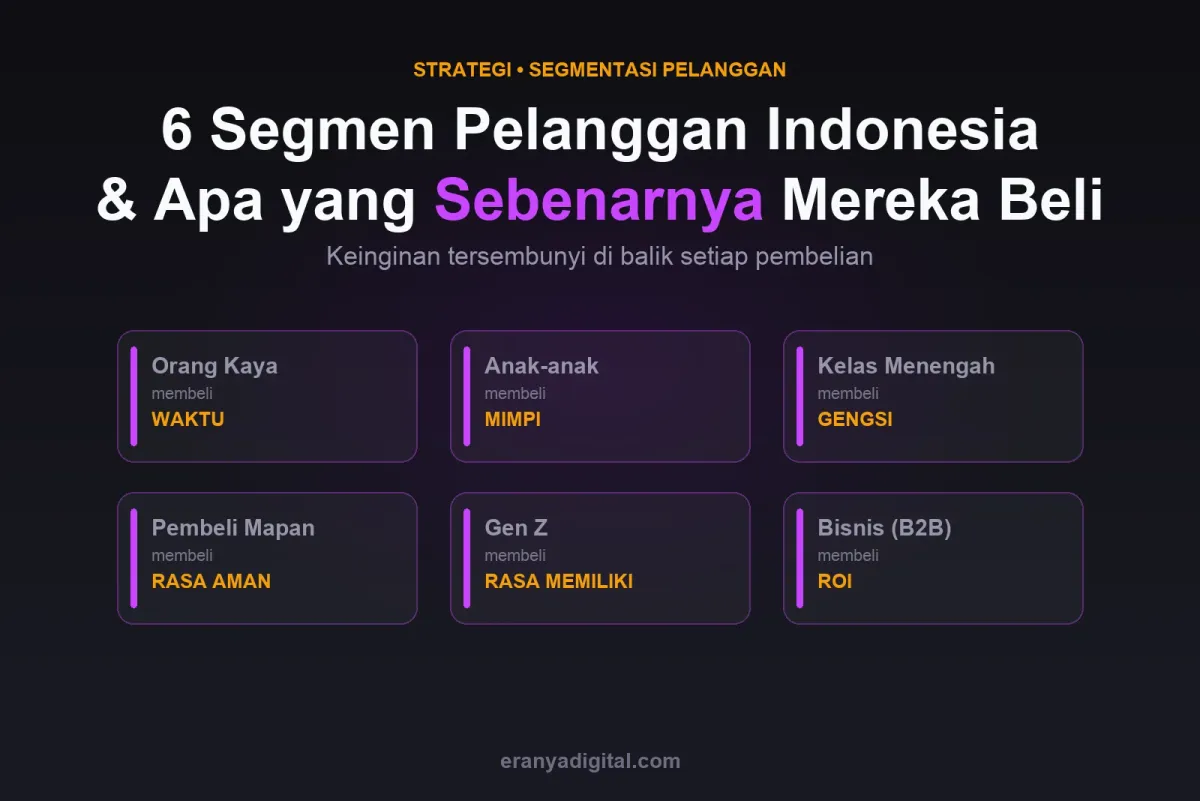
There’s one expensive mistake nearly every business owner makes: assuming customers buy the product you sell. They don’t. Customers buy a better version of themselves — more time-efficient, more respected, safer, more accepted. Good customer segmentation starts by answering the question most people get wrong: not “who buys?”, but “what are they really buying beneath the product?”
The same product can mean very different things to six different people. An identical cup of coffee is a “morning time-saver” for a busy executive, an “Instagram-worthy prestige spot” for the middle class, and a “community hangout” for Gen Z. If you sell to all of them with the same message, you don’t connect deeply with anyone.
This article is a complete map of 6 customer segments in Indonesia and the hidden desire of each. This is a hub article linking to our full customer behavior series — bookmark it, because you’ll return every time you build a new campaign.
Quick Verdict: 6 Segments & What They’re Buying
| Segment | Product Sold | What’s Actually Bought | Primary Trigger |
|---|---|---|---|
| Wealthy / financially established | Premium goods & services | TIME & ease | Efficiency, exclusivity |
| Children (via parents) | Toys, education, entertainment | DREAMS & happiness | Parent emotion, future aspirations |
| Middle class | Products & experiences | Affordable PRESTIGE | Status, social recognition |
| Boomers / established buyers | Health, finance, services | SAFETY | Trust, minimal risk |
| Gen Z | Fashion, F&B, lifestyle | BELONGING | Identity, community, authenticity |
| Business buyers (B2B) | Solutions & services | ROI | Numbers, credibility, proven results |
💡 Pro Tip: Pin this table near your workspace. Before writing a single line of advertising, ask: “Which segment am I talking to, and what are they actually buying?” The answer determines your headline.
Why Segmentation Determines a Small Business’s Survival
Indonesia isn’t one market — it’s dozens of overlapping markets. SMEs contribute approximately 59–61% of national GDP and numbered more than 56 million business units in 2024.1 This means brutal competition, and the winners aren’t the cheapest — they’re the most relevant to a specific segment.
The problem is most SME owners try to be “all things to all people.” The result: bland messaging, wasted ad spend, and customers who don’t feel “this is for me.” Segmentation fixes this by forcing you to choose. When you know what your segment is emotionally buying, you can raise prices (because you’re selling value, not product), cut your ad budget (because you’re targeting precisely), and write copy that feels personal.
Remember the core principle we cover in Buyer Psychology: people buy on emotion, pay with logic — segmentation is how you find which emotion moves each group.
⚠️ Watch out: Don’t chase all six segments at once. Small businesses win by focusing. Pick 1 core segment to win completely, then expand. Spreading thin across all segments is the fastest way to run out of budget with no results.
Segment 1 — The Wealthy Buy TIME (not goods)
The biggest misconception about the affluent segment: they buy luxury to show off. Some do, but their deepest motivation is time and ease. McKinsey research on affluent consumers shows their top priority is convenience and experiences that save effort — not just expensive labels.2 They’ll pay a premium to skip queues, get pickup-and-delivery service, or reduce 10 steps to 1.
Concrete example: A beauty clinic can sell “90-minute facial package” (feature) or “no queue, private room, done by lunch” (time). The wealthy segment chooses the second — and is willing to pay 2x for it.
REAL TIPS (sell “time” to busy people):
- Replace feature language with time language: “saves 3 hours”, “done in a day”, “no back-and-forth.”
- Offer a premium “done-for-you” tier. Many wealthy people pay more specifically not to handle the details.
- Reduce checkout friction. Every extra click is a reason to leave. A slow website = wasted time = losing this segment.
Segment 2 — Children Buy DREAMS (with parents’ money)
Children rarely pay themselves, but they hold the most powerful emotional veto. What’s actually being bought isn’t toys or tutoring — it’s dreams: a child’s happiness now and a brighter future in the parent’s eyes. The final decision rests with parents, and parents buy with their hearts.
Concrete example: A music school advertising “piano lessons, 12 sessions” sells features. The winner sells a dream: “imagine your child performing confidently at their first recital.” A photo of a smiling, proud child outperforms any curriculum list.
REAL TIPS (sell “dreams” to parents):
- Show transformation outcomes (before/after), not process. Parents are buying their child’s future.
- Use social proof from other parents (“my child became so much more focused…”).
- Relieve parental guilt and worry — money-back guarantees, free trials, regular progress updates.
Segment 3 — The Middle Class Buys Affordable PRESTIGE
This is the largest and most important segment for the majority of Indonesian SMEs — and the most misread. Indonesia’s middle class is increasingly quality-conscious and brand-aware, with growing demand for branded products and premium experiences.3 But they’re also increasingly careful: NielsenIQ data shows Indonesian consumers are more selective and hunting for “good deals” amid economic pressure.4
The combination produces a hidden desire: affordable prestige. They want to appear to be moving up in class, but at a price they can logically justify. They’re buying status symbols that “make sense.”
Concrete example: A coffee shop selling “Rp 18,000 coffee” competes on price. The winner sells “an Instagram-worthy cup and interior” — customers pay for a photo they can show off, not just the caffeine. Prestige priced at one cup of coffee.
REAL TIPS (sell “affordable prestige” to the middle class):
- Make your product “shareable” — packaging, photo spots, unboxing moments.
- Use anchor pricing: show the premium option first so the middle tier feels smart and affordable.
- Communicate status without making them feel wasteful. “Premium café quality at a reasonable price.”
Segment 4 — Boomers & Established Buyers Purchase SAFETY
The mature-age and established buyer segment has high purchasing power and loyalty — but they operate on one principle: minimize risk. What they buy isn’t the product; it’s safety and peace of mind. They fear making the wrong choice, being deceived, wasting money. Win that fear, and you get customers for life.
This loyalty is tangibly valuable: Indonesia’s loyalty program market is estimated to grow 10.7% to approximately US$1.84 billion in 2024.5 Segments that feel safe stay and recommend.
Concrete example: For financial or health services, testimonials like “serving for 15 years”, clear licensing, guarantees, and real team faces sell far better than discounts. This segment buys trust, not promotions.
REAL TIPS (sell “safety” to established buyers):
- Thicken trust signals: certifications, guarantees, named testimonials, real team photos, physical address.
- Simplify choices. Too many options trigger doubt and delay decisions.
- Provide a human conversation channel (phone/WhatsApp). This segment wants to be reassured by a person, not a chatbot.
Segment 5 — Gen Z Buys BELONGING
Gen Z doesn’t buy products; they buy identity and community membership. Research shows they crave authenticity and want to “find their tribe” — winning brands are those that fill the need to belong.6 In Indonesia, Gen Z purchasing decisions are heavily influenced by lifestyle, social media, and FOMO mentality.7
But be warned: Gen Z detects inauthenticity fastest. They’ll withdraw trust the moment they smell manipulation or “greenwashing.” Belonging can only be sold sincerely.
Concrete example: A local fashion brand selling ”30s combed cotton t-shirts” sells a commodity. The winner sells a “movement” — shared values, a Discord/Instagram community, content that invites participation. Customers become members, not just buyers.
REAL TIPS (sell “belonging” to Gen Z):
- Build community, not just audience. Invite them to co-create (voting on variants, user-generated content).
- Show real values through action, not slogans. Authenticity > perfection.
- Leverage FOMO signals ethically: limited drops, early access for members.
Segment 6 — Business Buyers (B2B) Purchase ROI
Moving to business buyers, the rules change. B2B buyers purchase ROI — measurable results. On the surface, their decisions are rational: numbers, efficiency, savings. In reality B2B processes are complex, often involving 6–10 decision-makers, and most consider their last major purchase “difficult.”8
Interestingly, though ROI sounds cold, research shows emotion still plays a role in roughly half of B2B decisions — career safety, fear of being blamed for a wrong choice. So you’re still selling emotion, but wrapped in logical justification. We break down the nuances in Trust Signals: B2B vs B2C.
Concrete example: A software vendor saying “feature-rich” loses to one saying “Client X saved 40 hours/month and broke even within 3 months.” B2B needs concrete numbers to bring into internal meetings.
REAL TIPS (sell “ROI” to business buyers):
- Translate features to numbers: time saved, costs reduced, revenue gained.
- Prepare ammunition for internal champions: case studies, ROI calculators, one-pagers that can be forwarded to management.
- Strengthen credibility: client logos, certifications, retention figures. This lowers the perceived risk for the decision-maker.
Priority Matrix: Which Segment to Start With?
You can’t chase all of them. Use this matrix to choose your core segment — score each segment 1–5 on two axes, then pursue the one with the highest combined score:
| Criterion | Question to answer |
|---|---|
| Purchasing power | How much are they able and willing to pay for this problem? |
| Reachability | Can I reach them with my current ad budget? |
| Product fit | Does my product already answer their hidden desire? |
| Margin | What’s the net profit per customer from this segment? |
| Loyalty/repeat | How likely are they to buy again? |
This Week’s Action Checklist
- Write the 6 segments. Circle 1 core segment that’s most profitable today.
- Write one sentence: “My customers are actually buying ______.”
- Audit your website’s main headline and photo: does it speak to the core segment’s hidden desire?
- Fix one element (headline / photo / price) to better match that segment.
- Build your core segment’s customer profile from real data (transactions, chats, reviews), not guesswork.
💡 Pro Tip: Segmentation isn’t a one-time exercise. Review it every quarter. Segments shift — the middle class that used to hunt for prestige can pivot to value-hunting when the economy tightens, precisely as recent Indonesian consumer data shows.4
Common Mistakes That Make Segmentation Fail
Even with the right map, many businesses stumble in execution:
- Equating demographics with segments. “Women 25–35” isn’t a segment — that’s ID card data. Segments are determined by hidden desire, not age. Two same-age women can be in completely different segments.
- Selling features to everyone. Same features, but the emotional promise must differ per segment.
- Forgetting segments drift. When your message is no longer relevant, they quietly leave. Learn the signals in Why Customers Quietly Churn.
- Not connecting segments to the “job” they’re hiring for. Segmentation answers who you serve; the next step is mapping what job your product does for them — two lenses that complement each other.
FAQ
What is customer segmentation and why does it matter for small businesses? Customer segmentation divides a market into groups with similar needs, motivations, and buying behavior. For SMEs it matters because you can’t serve everyone with the same message. Knowing which segment you serve makes your ad budget, copywriting, and pricing far sharper and more efficient.
How do I identify the right customer segment for my business? Start with existing data: who buys most often, what they complain about, the real reason they buy. Combine that with demographic signals (purchasing power, location) and psychographic signals (values, aspirations). One business typically serves 2–3 segments, not all six simultaneously.
Can one product target multiple segments at once? Yes, but the message must differ. The same product can be sold as a “time-saver,” “status symbol,” or “safe choice.” What changes isn’t the product — it’s the emotional promise and how you package it in ads, landing pages, and product photos.
What’s the difference between selling to B2C and B2B customers in Indonesia? B2C is more emotion-driven — prestige, safety, belonging — with relatively fast purchasing. B2B buyers purchase ROI: they need number-backed justification, credibility proof, and often involve multiple decision-makers. B2B content needs more data and case studies.
Which segment is most profitable for a small business in Indonesia? Depends on product and margins. The middle class is largest by volume but price-sensitive. The affluent/senior segment has high purchasing power and loyalty if you win on safety. The safest move: win one core segment first, then expand.
Next Steps
This map of 6 segments is only useful when translated into actual website copy, ads, and offers. The good news is every segment leaves a trail: their hidden desire determines what headline to run, what photo to show, and what price feels “right.”
If you want to know which segment you’re actually serving — and whether your website speaks to their hidden desire — we’re ready to help you map it together.
Want us to audit your customer segments and website message, then give concrete recommendations? Free consultation →
References
Footnotes
-
Databoks Katadata. (2024). UMKM Contribution to Indonesia’s GDP 2020–2024. databoks.katadata.co.id — Ministry of Cooperatives data: 56.14 million SME units and approximately 59.64% GDP contribution in 2024. ↩
-
McKinsey & Company. (2024). Why courting aspirational luxury consumers still matters. mckinsey.com — Analysis of affluent segment prioritizing convenience, personalization, and experience over labels. ↩
-
Kadence. (2024). Indonesia Market Research: Key Consumer Trends You Must Know. kadence.com — Indonesia’s middle class is increasingly quality-conscious and brand-aware, with growing premium product demand. ↩
-
NielsenIQ. (2024). Indonesia Mid-Year Consumer Outlook Guide to 2025. nielseniq.com — Indonesian consumers are more selective, value-hunting under cost-of-living pressure. ↩ ↩2
-
ResearchAndMarkets.com. (2024). Indonesia Loyalty Programs Market Databook 2024 (via PR Newswire). prnewswire.com — Indonesia’s loyalty market estimated to grow 10.7% to ~US$1.84 billion in 2024. ↩
-
Forbes Communications Council. (2024). The Power Of Community: How Fashion Brands Are Building Loyalty Among Gen Z. forbes.com — Gen Z craves authenticity and belonging (“finding their tribe”) as loyalty drivers. ↩
-
Media Indonesia / Populix. (2024). Populix Shares Online Shopping and Digital Investment Trends in 2024. mediaindonesia.com — Populix research: Indonesian Gen Z purchasing is influenced by lifestyle, social media, and FOMO. ↩
-
Gartner. (2023). How the B2B Purchase Journey is Evolving for Software Buyers. gartner.com — Complex B2B buying group involving many decision-makers, with ROI and price as final determinants. ↩
Questions About Customer Segmentation in Indonesia
What is customer segmentation and why does it matter for small businesses?
Customer segmentation is the process of dividing a market into groups with similar needs, motivations, and buying behavior. For small businesses, it matters because you cannot (and should not) serve everyone with the same message. Knowing which segment you're serving makes your ad budget, copywriting, and even pricing far sharper and more efficient.
How do I identify the right customer segment for my business?
Start with the data you already have: who buys most often, what they complain about, and the real reason they buy (not just the product). Combine that with demographic signals (age, purchasing power, location) and psychographic signals (values, lifestyle, aspirations). One business typically serves 2–3 segments, not six simultaneously — focus on the most profitable one.
Can one product target multiple segments at once?
Yes, but the message must differ per segment. The same product can be sold as a 'time-saver' to busy people, a 'status symbol' to the middle class, or a 'safe choice' to older customers. What changes isn't the product — it's the emotional promise and how you package it on your landing page, ads, and product photos.
What's the difference between selling to B2C and B2B customers in Indonesia?
B2C customers are more emotionally driven — status, safety, belonging — and complete purchases relatively quickly. B2B buyers purchase ROI: they need number-backed justification, credibility proof, and often involve multiple decision-makers. B2B content needs to be richer in data, case studies, and outcome calculations.
Which segment is most profitable for a small business in Indonesia?
There's no single answer — it depends on your product and margins. The middle class is the largest segment by volume in Indonesia, but most price-sensitive and hungry for 'affordable prestige.' The affluent/senior segment has high purchasing power and loyalty if you win on safety and trust. The safest approach: win one core segment first, then expand once your position is solid.